
Curved Glass Surface Stress Measurement: Jeffoptics Edge Stress Gauge vs Traditional Optical Meters
Sep 20, 2026
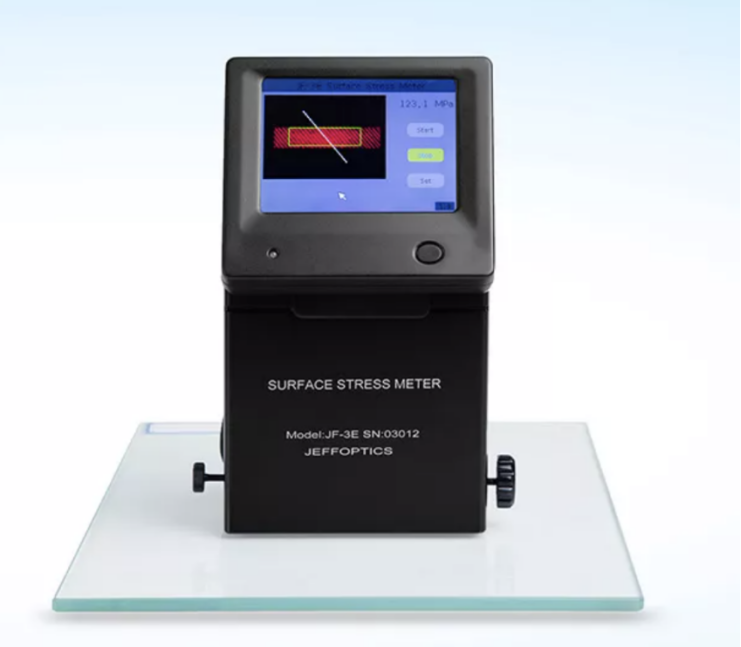
Beijing, China Sep 20, 2026 (Issuewire.com) - Modern architectural facades, automotive panoramic sunroofs, and advanced electronic cover displays increasingly rely on complex curved geometries. Manufacturing these components requires precise mechanical tempering and chemical strengthening to withstand high mechanical loads and thermal shocks. However, measuring surface stress on curved surfaces presents significant metrology challenges. Traditional optical meters often struggle with irregular radii, leading to high measurement errors, operator subjectivity, and inconsistent quality control on the production line. When procuring testing instruments, engineering and quality assurance teams must look beyond basic catalog specifications. Evaluating parameters such as optical resolution, measurement repeatability, sample curvature adaptability, and compliance with international testing standards prevents costly production defects. Selecting the right equipment ensures that tempered and strengthened glass components meet rigorous safety thresholds required for global deployment.
Jeffoptics Edge Stress Gauge vs Traditional Optical Meters
Choosing between modern automated instrumentation and legacy measurement devices directly impacts plant efficiency and product pass rates. Understanding the core operational differences helps technical buyers match their inspection workflows to appropriate analytical tools.
Operational Mechanics and Setup Complexity
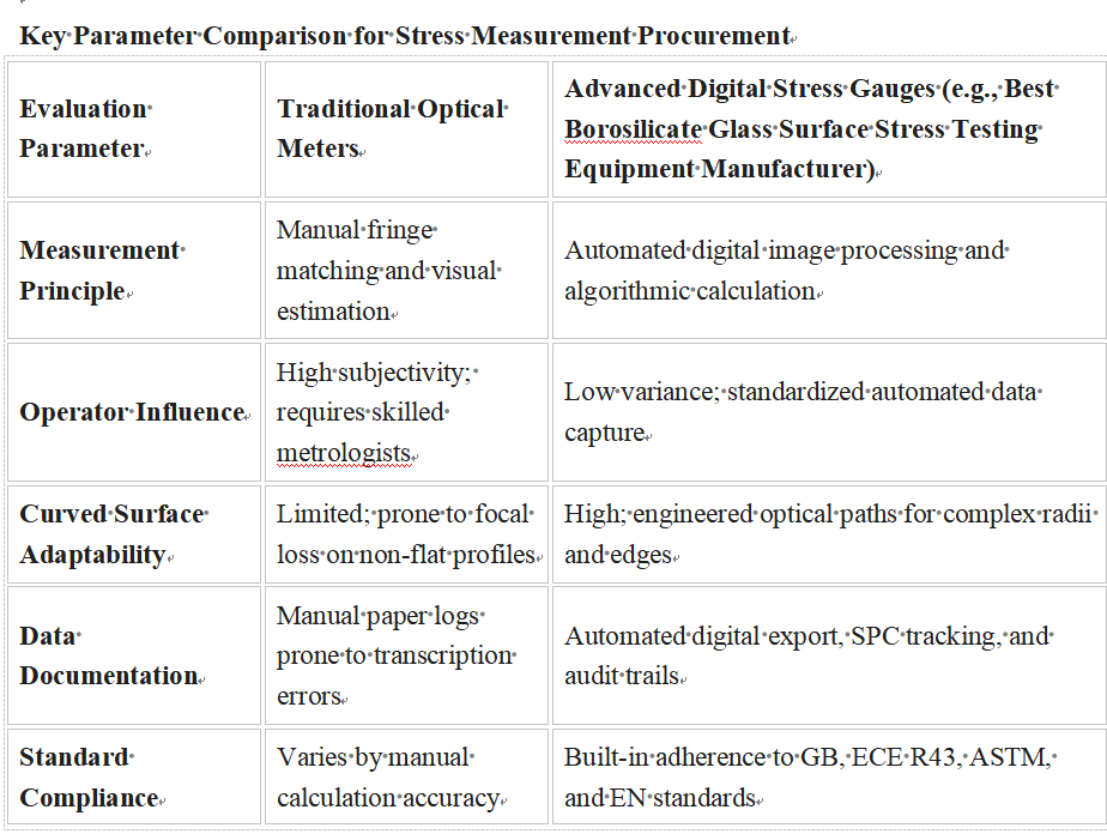
Traditional optical meters rely heavily on manual polariscopic fringe interpretation. Operators must manually align optical components, count retardation fringes, and calculate stress values based on visual charts. This process introduces human subjectivity, requires extensive operator training, and increases measurement variance between shifts. In contrast, advanced systems automate light path alignment and digital image capture. Modern digital units process fringe patterns algorithmically, delivering repeatable numerical stress values within seconds regardless of operator experience.
Handling Complex Geometries and Curved Surfaces
Measuring stress on curved or edge-bent glass poses severe limitations for traditional flat-field optical meters. Legacy devices often fail to maintain proper optical contact or focal depth along non-uniform radii, resulting in blank or distorted viewing fields. Dedicated inspection tools utilize specialized optical compensation and adjustable staging designed specifically for curved profiles. This technical adaptation allows precise surface and edge stress evaluation on complex automotive and architectural glass without requiring destructive sample preparation.
Calibration, Traceability, and Data Integration
Quality auditing requires verifiable data trails. Traditional meters rarely offer digital export capabilities, forcing technicians to manually record readings in paper logs, which introduces transcription errors. Contemporary stress measurement instruments integrate automated data logging, statistical process control (SPC) charting, and direct database export. These digital features ensure full traceability required by tier-one automotive and architectural clients while streamlining compliance documentation for ISO-audited facilities.
Core Competencies, Technological Innovation, and Industry Solutions
Establishing reliable quality control in high-volume glass manufacturing requires robust engineering capabilities and adherence to internationally recognized testing standards. Beijing Jeffoptics Technology Co., Ltd. operates as a National High-tech Enterprise specializing in optical inspection instruments for glass quality control. Certified under the ISO 9001 Quality Management System, the enterprise designs high-precision metrology solutions that align with global regulatory requirements.
The company's core product portfolio addresses diverse testing requirements across multiple industrial sectors. The JF series glass surface stress meters provide reliable evaluation for physically tempered glass, chemically strengthened glass, microcrystalline glass, fire-resistant glass, and photovoltaic patterned glass. Complementing these surface units, the AEM series glass edge stress meters target perimeter stress profiles, while the SIS series off-line secondary image separation test systems evaluate automotive safety glass optical distortion. All instruments comply with established standards including GB, ECE R43, ASTM, and EN, serving architectural, automotive, photovoltaic, and electronic cover glass manufacturers. With over 40 authorized patents and more than 10 computer software copyrights, the company delivers stable optical inspection equipment designed for rigorous industrial environments.
For specialized applications involving complex geometric profiles, advanced testing configurations enable accurate evaluation of curved components. Detailed technical implementations and deployment parameters can be reviewed on the Curved Glass Surface Stress Measurement Case Study. When integrating these systems into active production lines, procurement teams must verify that instrument measurement ranges correspond directly to the stress profiles of their specific material grades, avoiding calibration drift during high-throughput operations.
Frequently Asked Questions for Global Procurement Teams: What factors cause inconsistent readings when measuring chemically strengthened curved glass?
Inconsistent readings often stem from improper optical alignment against non-uniform radii, surface contamination, or failure to account for refractive index variations in specialized glass compositions. Utilizing fixtures specifically designed for curved geometry ensures stable optical contact and repeatable data capture.
How do international standards like ECE R43 and ASTM influence equipment selection?
Standards such as ECE R43 and ASTM mandate strict threshold limits for surface compression and edge stress in safety-critical applications like automotive glazing and architectural installations. Procurement teams must select instruments that natively calculate stress values in units recognized by these standards to pass external audits.
Can off-line stress meters be integrated into continuous automated manufacturing lines?
While traditional meters operate strictly off-line as spot-check tools, advanced testing platforms offer modular configurations or paired on-line secondary image separation test systems that accommodate higher sampling frequencies without bottlenecking production flow.
What is the primary cause of procurement failure when purchasing glass stress measurement tools?
A common failure mode is purchasing generic flat-surface testers for facilities that predominantly manufacture complex curved or edge-bent architectural glass. Buyers must match the instrument staging and optical depth-of-field to their actual product catalog before finalizing equipment contracts.
How can buyers verify supplier technical capability and patent portfolios?
Buyers should request formal documentation of authorized patents, software copyrights, and third-party calibration certificates. Suppliers holding certified ISO 9001 Quality Management Systems provide verifiable design controls and manufacturing consistency.
Optimizing Quality Control for Complex Glass Geometries
Integrating advanced metrology instruments into active manufacturing environments requires aligning equipment specifications with specific production throughput and material constraints. Facilities processing high volumes of architectural and automotive glass benefit from structured evaluation workflows that assess measurement repeatability, compliance documentation, and operator usability. To review comprehensive technical specifications, system configurations, and implementation methodologies tailored to your production requirements, please visit the official corporate portal at https://www.jeffoptech.com/
Source :Beijing Jeffoptics Company Limited
This article was originally published by IssueWire. Read the original article here.
Hot News











YOUR NEWS, OUR NETWORK.
Do you have Great News you want to tell the world?
Be it updates about your business or your community, you can make sure that it’s heard by submitting your story to our network reaching hundreds of news sites across 6 verticals.